


3 April, 2017 - Wifi networks have become one of the preferred methods of accessing the internet. Everywhere: at home, in the company, at school, in the hotel, at the stadium, etc. Everywhere we go we expect to find a good WiFi network.
In addition, improvements in access points and user terminals are continually being introduced. So, when designing a WiFi solution, how can we assess whether all these new devices will perform adequately and according to the expected performance? Will the number of users using them affect the quality of services?
What if we could analyse different deployment scenarios before actually doing them physically?
And once WiFi is installed, is the capacity of the network as expected with tens or hundreds of users?
Today's WiFi networks must support multiple HD video streams (including OTT - Over The Top services), real-time services (VoiP) and all kinds of bandwidth-hungry devices, such as HDTVs, laptops, tablets and smartphones. In addition, users have become very dependent on WiFi services and expect a great WiFi service, no matter what device you use and/or where you are. However, WiFi technology has limitations due to the use of low power and limited shared spectrum. This means that not all Access Points (APs) are the same, as they do not all solve the capacity problem in the same way. Some have multiple processors, others have better antenna arrays, others use special chips that perform optimally at certain frequencies and/or loads. This is why some manufacturers have better results for the same scenario than others.
However, during these years most of the recommendations and best practice guides for the deployment of WiFi networks have been oriented towards achieving good radio coverage. Thus we can see below a graph with a typical example of a coverage map.
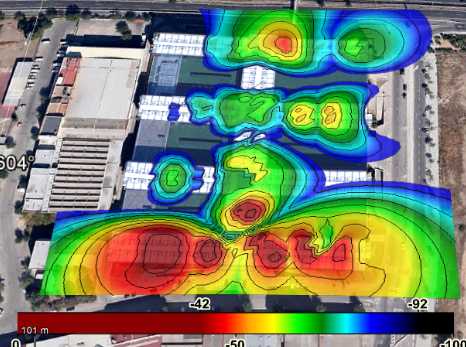
This basic approach has proven to be incomplete. Users demand not only coverage, but also high quality services at all times, and as mentioned before, not all APs behave the same when processing traffic. In addition, with the emergence of MIMO systems, RF analysis is no longer as accurate as it used to be, as network capacities are now also conditioned, among other things, by the type of traffic, number and location of users/stations.
The ideal would be to measure the behaviour of networks with multiple services and also according to the number of connected terminals. This is usually very complex and prohibitively expensive, because if we want to see how a WiFi network behaves with 100 users (PCs and/or mobile users) we would have to deploy 100 devices in the scenario. Then we would have to figure out how to see the quality of the services and the bandwidth that each one gets, so that we could then validate the WiFi installation for, for example, a trade fair, an auditorium, or a sports centre.
Fortunately, such scenarios can nowadays be tested with what we call WiFi network simulators/generators without the need to deploy tens or hundreds of pieces of equipment in the field.
One example is the graph at the top of the article, which shows how the performance of the high-end access point drops as a function of the number of stations, going from a maximum traffic capacity of 700Mbps with one user to just over 500Mbps for 30 stations. That is, a performance drop of around 28% when loaded with simultaneous traffic from 30 devices.
Another view of the behaviour of our WiFi would be obtained by analysing the traffic received by each of the connected devices. Here we can see a graph, as an example, of the bandwidth per device for an installation with 30 devices. For this scenario we are getting between 12Mbps to 13Mbps per WiFi device.
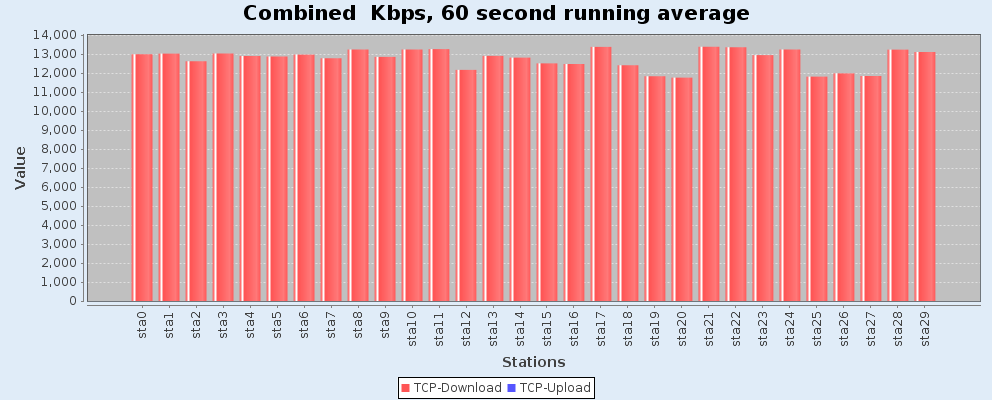
In this way, we could choose and validate which access point delivers the most bandwidth according to the number of users foreseen for our project. Or we could also verify, in the field, that the WiFi network is really delivering the bandwidth committed per device and with the quality required for the services provided to users.
You no longer have to design blindly and then trust that what the technical documentation says about the equipment will be fulfilled when you deploy the project.
Aplicaziones has been advising its customers on the quality of WiFi networks for years and we can attest that we encounter many surprises when a WiFi network is loaded with multiple traffic and users. Some equipment (APs) hardly notice the difference, but others can lose more than half of their performance.
Para este tipo de trabajos utilizamos diferentes herramientas y queremos destacar en este artículo la instrumentación de Candela Tecnologies, empresa americana con la que tenemos un acuerdo para el mercado Iberico.
For this type of work we use different tools and we would like to highlight in this article the instrumentation of Candela Tecnologies, an American company with which we have an agreement for the Iberian market.
In the photo below you can see a portable model that we provide to our customers to validate their projects. This equipment is also sold to specialised companies that want to test their WiFi installations themselves.
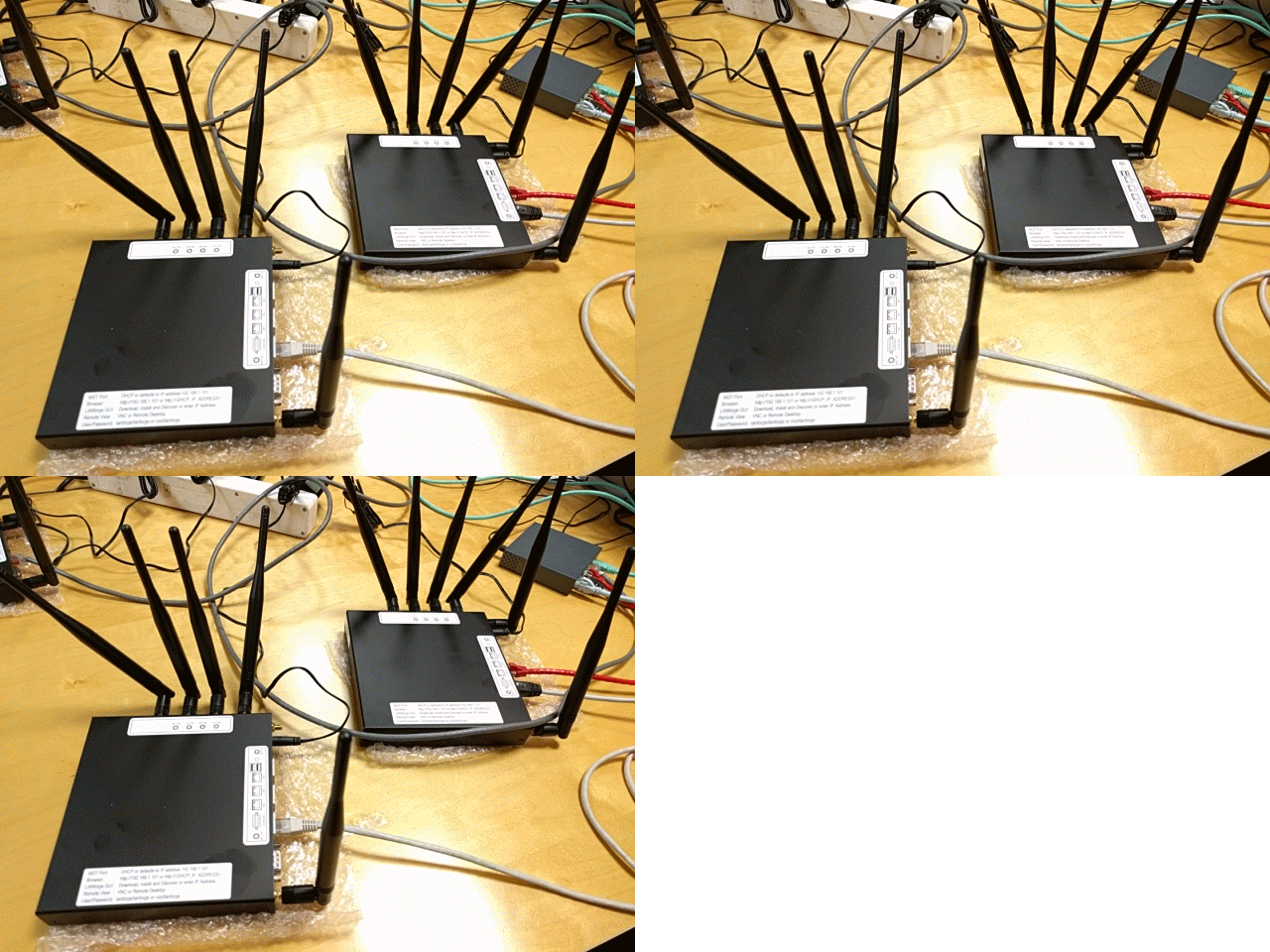
These are some of the main features of these devices:
- Dual radio (2.4Ghz and 5Ghz) with a/b/g/n/ac
- Possibility to generate multiple virtual stations from each unit (up to 64), each with separate subnets and specific traffic.
- Several of these devices can be put to work in cluster mode to simulate complex scenarios as realistically as possible.
- Multiple connection speeds (MCS) and multiple streams (3*3 or 4*4) are configurable
- Multiple traffic generation and virtual station behaviour capabilities
- Possibility of integrating measurements of the perceived quality of services (VoIP or HDVideo).
- The devices are fanless and very small. Very suitable, for example, to be carried in a backpack by the field personnel in charge of testing.
With these test kits we can simulate and certify scenarios with multiple radios and hundreds of devices.
For larger projects, there is even more powerful equipment, also with multiple radios and capable of generating thousands of virtual stations.
As WiFi networks are being deployed with higher performance equipment (e.g. WiFi AC Wave 1 or Wave 2), it is becoming more convenient to verify their real capabilities with instrumentation of this type. On the one hand, so that AP manufacturers do not "pull the wool over our eyes", but above all to configure and understand the possibilities that these technologies offer us, thus obtaining the best performance and quality of WiFi services in our projects.
This type of testing not only allows us to identify APs that have more or less performance, but also to facilitate an optimal adjustment in the location of the APs in the field: For example, a good deployment of APs can lead to an aggregate traffic of more than 20%. This difference can mean, in some cases, meeting or not meeting the SLAs committed to our customers.
With the arrival of the new generation of 802.11ax WiFi networks, it will be even more important to define the test protocols for our project and the correct choice of instrumentation for measuring the performance of these new systems.
More information is available in our network quality area network quality area and/or by contacting Aplicaziones.